Rolodex
The Cole Group places CMOs and CROs at companies like OpenAI, Stripe, Airbnb, and Figma, whose CEOs were slow to decide on a hire most only make once or twice. How do you build the confidence to move faster?
- +16%
- revenue
- 13%
- faster searches
- +25%
- concurrent search capacity
Context
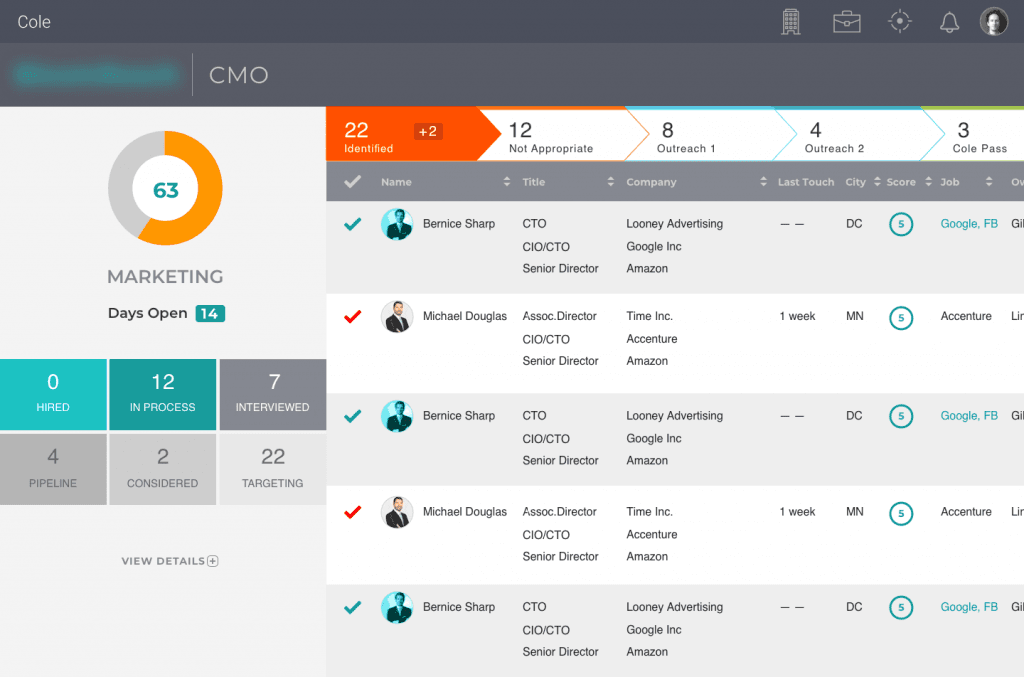
The Cole Group is an executive recruiting firm that places CMOs and CROs at high-growth, VC-backed companies. I was hired to build an internal tool, internally called Rolodex, to increase recruiter efficiency: company and candidate databases, data analysis and visualization, outreach and nurture tools, and more.
The founders' initial challenge was narrower: clients were slow to make a hire. Few CEOs have hired a CMO or CRO before, and understandably, they want to be sure. We used house-hunting as the analogy: tools like Redfin and Zillow give buyers enough data to feel confident deciding fast. My first objective was to build a tool that did the same for hiring.
Research & discovery
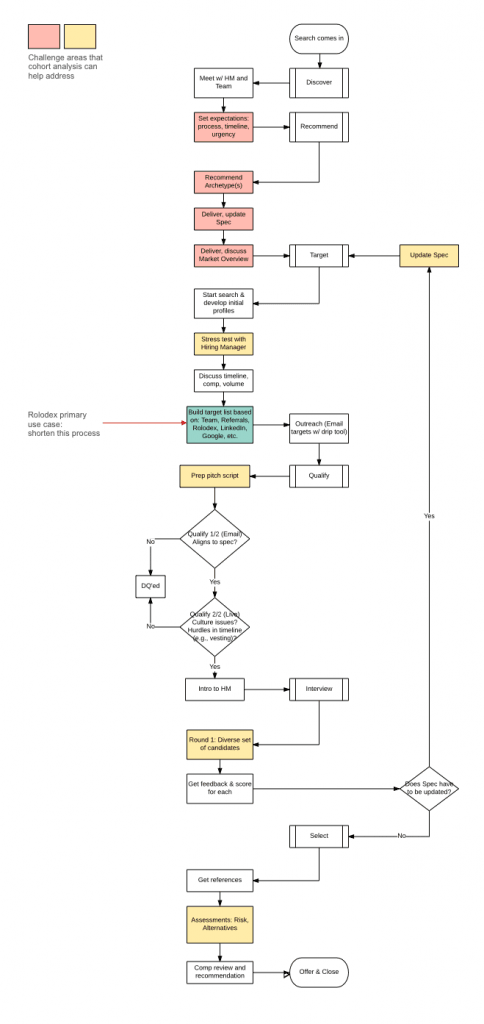
I interviewed every recruiter, executive assistant, and accounting staffer, sat in on client meetings, and went through historical Salesforce data. That surfaced a task flow mapping the recruiting process end to end, and the points of friction in it, refined over several rounds of feedback from founders and recruiters.
The cohort analysis tool
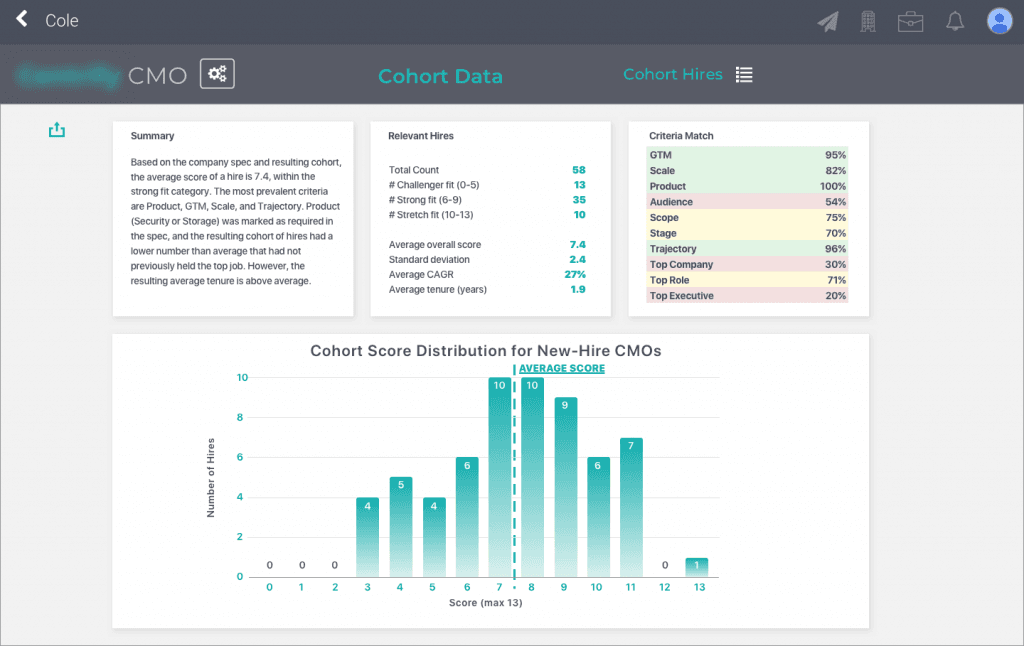
To address time-to-conviction, the first feature was a cohort analysis tool: "here's how companies like yours have hired." Given a job spec (the desired candidate criteria), it showed the distribution of past hires and how many criteria they met on average, helping clients see patterns like whether hires skewed junior-from-larger-companies or senior-from-smaller ones.
That required real data: twenty years of unstructured internal placement history, VC partner data (a large share of executive hiring runs through portfolio companies), and public sources filled in through Mattermark's API. We built formulas to estimate seniority and company revenue from sparse signals, and developed hypotheses for what actually constitutes a "good hire."
Prioritization & execution
I segmented goals into product, process, and research/dependency buckets, prioritized by value to Cole versus effort, with feedback from founders and recruiters, then scored individual tasks to keep bias out of the more granular calls. Everything became PRDs in Confluence and epics/tickets in Jira.
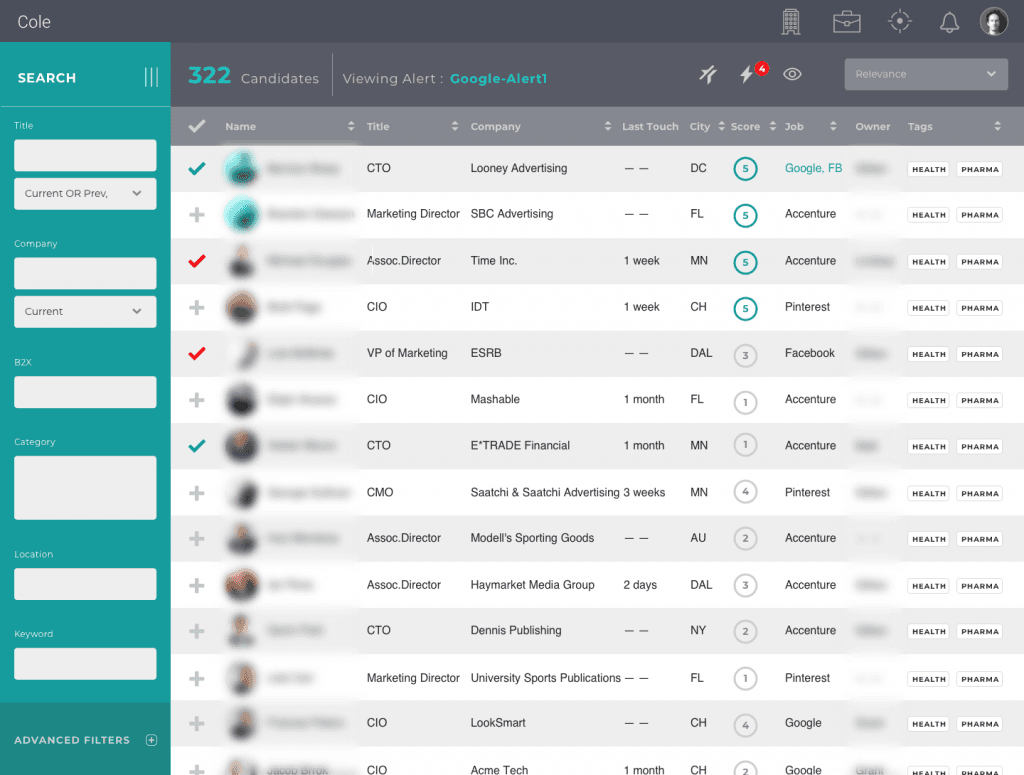
Working within an existing but loose design system, I partnered with our designer in Sketch and then Figma and ran two-week sprints with engineering: candidate profiles and assessments, company profiles, search and results pages, reference forms, email automation, pipeline and funnel tracking, and analytics. We layered in third-party integrations like RocketReach and facial recognition to help auto-code candidate diversity (99% accurate, with manual override), minimizing manual assessment wherever we could.
Results
Revenue increased 16%. Recruiters closed searches 13% faster, took on 25% more concurrent searches, and customer satisfaction, already high, rose another 7%. Recruiters also rolled entirely off Salesforce once Rolodex covered what they needed, saving six figures in licensing and resolving recurring Lightning integration issues along the way.
- +16%
- revenue
- 13%
- faster searches
- +25%
- concurrent search capacity